Hearing health
Why hearing health matters
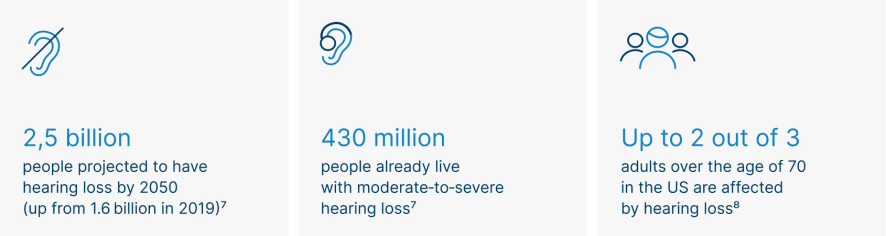
Healthy hearing plays a fundamental role in everyday life: it supports communication, safety, and meaningful human connection. When hearing loss goes untreated, these aspects can be affected, limiting social participation and reducing quality of life. Today, 1.57 billion people worldwide live with hearing loss, a number expected to rise to 2.45 billion by 2050.¹
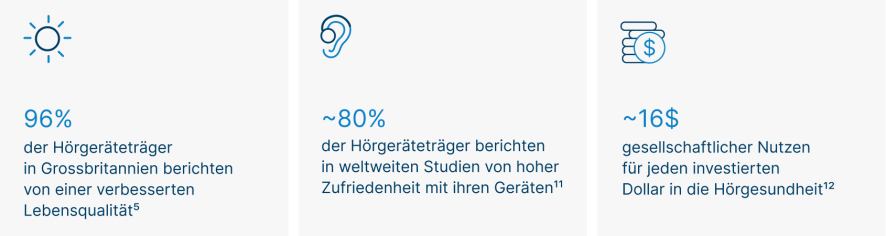
The good news is that hearing care can make a real difference. Properly fitted hearing aids can improve speech understanding, reduce listening effort, and help people stay socially active.2,3,4 Regular surveys with people using hearing devices across regions point to a common benefit of hearing care: in the UK, 96% of hearing-aid users report improved quality of life after receiving care,5 with very similar results for China (98%) and the US (96%).6
Ensuring that people can benefit from care depends on access and choice. A range of technology options, supportive reimbursement models, and trained hearing care professionals all play a role in making hearing care more widely available.7
A hearing test is a simple first step, and early care can make a lasting difference.
How is your hearing today?

Hearing health worldwide

Understanding hearing and hearing loss
Hearing is something most people don’t think about until it becomes more difficult. It relies on a series of small, connected steps. Sound travels through the outer ear, passes the middle ear, and is converted into signals in the inner ear that the brain can interpret.
Hearing loss can occur at any point in this process. A blocked ear, such as from earwax, can make sounds seem quieter. Infections or stiffness in the middle ear can affect how sound is passed on. In the inner ear, long-term noise, ageing, or illness can damage the delicate cells responsible for hearing.
For many people, these changes happen gradually—for example, finding it harder to follow conversations in a busy restaurant. Understanding where the change occurs helps hearing care professionals recommend the right support, helping people stay connected in everyday life.

“Hearing well is essential for people to connect with others and to stay socially active. Research shows that hearing care improves communication, can reduce listening effort and supports brain health. With millions still lacking access to care, expanding hearing care is essential to support healthy hearing and healthy aging.”
Maren Stropahl, Senior Director Holistic Hearing Care
Untreated hearing loss can influence how people communicate, connect, and participate in life. Learn about different types of hearing loss, early signs, and when to seek support, and discover how timely care can help protect brain health, well‑being, and quality of life.7
Hearing health drives well-being
Hearing health plays an important role across social, cognitive, and physical well-being.9 Evidence shows that timely care and rehabilitation can support all three—helping people stay connected, support brain health, and engage fully in everyday life.10
Looking after your hearing helps you follow conversations more easily, and stay connected in everyday life. Explore practical steps to protect your hearing and learn how everyday actions can help maintain healthy hearing over time.
Join us in hearing care
Helping people hear better takes more than technology—it takes people who care. At Sonova, we work to improve lives by making hearing care more accessible and effective around the world. Whether in research, product development, or hearing care, every role contributes to helping people stay connected in everyday life.

Footnotes
¹ Global Burden of Disease Hearing Loss Collaborators. (2021). Hearing loss prevalence and years lived with disability, 1990–2019, and projections to 2050. The Lancet, 397(10278), 996–1009. https://doi.org/10.1016/S0140 6736(21)00516 X
² Holman, J. A., Drummond, A., & Naylor, G. (2021). “Hearing Aids Reduce Daily-Life Fatigue and Increase Social Activity: A Longitudinal Study.” Trends in hearing 25(23312165211052786.). https://doi.org/10.1177/233121652110527
3 Ferguson, M. A., et al. (2017). “Hearing aids for mild to moderate hearing loss in adults.” Cochrane Database of Systematic Reviews 9(9). Doi:10.1002/14651858.CD012023.pub2
4 Reed, N. S., Chen, J., Huang, A. R., Pike, J. R., Arnold, M., Burgard, S., … & Lin, F. R. (2025). Hearing intervention, social isolation, and loneliness: A secondary analysis of the ACHIEVE randomized clinical trial. JAMA internal medicine, 185(7), 797-806. doi:10.1001/jamainternmed.2025.1140
5 Ehima (2025) EuroTrak 2025 UK. retrived from: https://www.ehima.com/surveys/ .
6 Dobyan, B., & Kihm, J. (2025). MarkeTrak 2025: Consumer Perspectives on Hearing Health in an Evolving Market. Seminars in hearing, 46(3), 178–183. https://doi.org/10.1055/s-0045-1812042
7 World Health Organization. (2021). World report on hearing. World Health Organization.
8Reed, N. S., Garcia-Morales, E. E., Myers, C., et al. (2023). Prevalence of hearing loss and hearing aid use among US Medicare beneficiaries aged 71 years and older. JAMA Network Open, 6(7), e2326320. https://doi.org/10.1001/jamanetworkopen.2023.26320
9 Vercammen, C., Ferguson, M., Kramer, S. E., Meis, M., Singh, G., Timmer, B., … & Pelosi, A. (2020). Well-hearing is well-being. Hearing Review, 27(3), 18-22.
10 Stropahl, M., an Seitz-Paquette, K. (2026). Holistic Hearing Care: New Technologies and Their Whole Person Benefits. Hearing Review, https://hearingreview.com/hearing-loss/health-wellness/holistic-hearing-care-new-technologies-whole-person-benefits
11 Ehima (2026, November 19). Hearing care, quo vadis? – What global surveys tell us about hearing aid awareness, adoption, and wellbeing. https://hearingyou.org/hearing-care-quo-vadis-what-global-surveys-tell-us-about-hearing-aid-awareness-adoption-and-wellbeing/
12 World Health Organization (2026, March 3). Deafness and hearing loss .https://www.who.int/news-room/fact-sheets/detail/deafness-and-hearing-loss
Latest Hearing health news